South Africa's Cannabis Export Dream is Stalling at the Infrastructure Gap
South Africa's cannabis sector has been sold, at home and abroad, as a transformational economic play. The pitch is a compelling one: tens of billions of rands in export revenue, jobs anchored in rural communities, and meaningful progress on broad-based black economic empowerment. Yet Charl Botha, a legal strategist and cannabis policy specialist writing in Business Day, argues that the gap between that promise and the structural reality on the ground is widening fast. The sector is not stumbling because ambition is in short supply, nor because licensing activity has stalled. It is stumbling because the institutional scaffolding required to support a functioning export industry simply has not been built.
The numbers that anchor government messaging are striking, to put it mildly. The Department of Trade, Industry and Competition's March update to the National Cannabis Master Plan projects annual sector growth of ten percent from a R14 billion base, while broader government communications reference a R28 billion opportunity. Those figures have done their job at attracting investor interest and political attention well enough. Botha's argument, though, is that they must now serve as a delivery benchmark rather than a promotional device, because the distance between the projected ceiling and current commercial reality is not a minor implementation lag. It is a structural failure in how the sector was designed and is being supported.
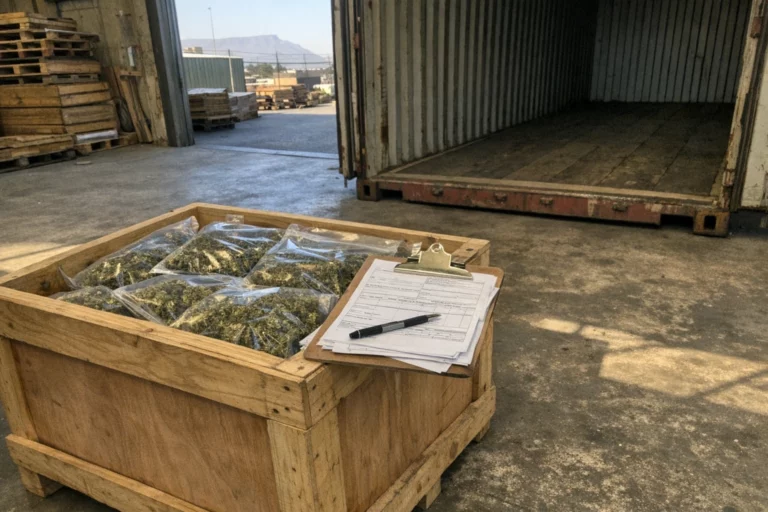
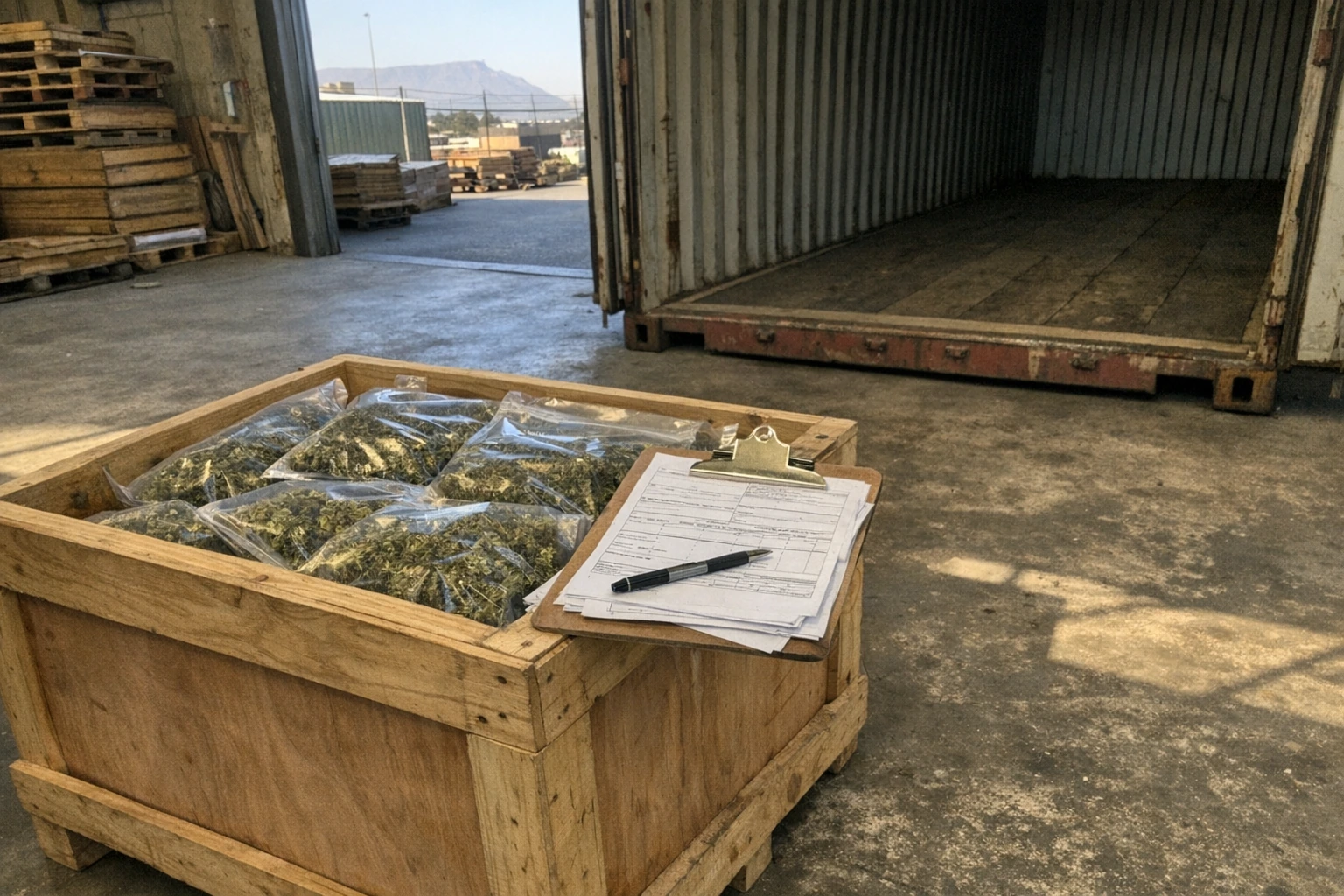
The core problem, as Botha frames it, is that the burden of building an export-ready industry has been offloaded almost entirely onto individual facility owners. A licence grants legal access to the regulated space, but it does not secure international buyers, guarantee recognition of South African good manufacturing practice (GMP) compliance, or resolve the practical bottlenecks, including delayed seed and genetics imports, constrained laboratory capacity, and shifting requirements in destination markets, that ultimately determine whether a consignment reaches a buyer and gets paid. Operators in the medicinal cannabis and export space are required by the South African Health Products Regulatory Authority (SAHPRA) to meet pharmaceutical-grade standards: GMP, good laboratory practices, and good agricultural and collection practices. Meeting those standards demands sustained capital expenditure on secure infrastructure, controlled growing environments, skilled personnel, quality management systems, and continuous compliance documentation, often for years before any meaningful revenue appears. (It is a lot to ask of a small producer sitting on red soil in Limpopo with an optimistic spreadsheet and a new licence.)
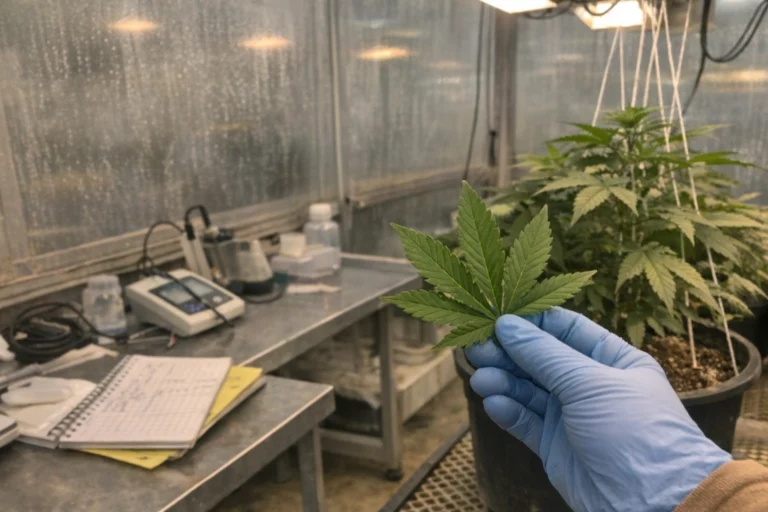
The testing infrastructure problem deserves particular attention. International buyers of medicinal cannabis do not simply want product. They want comprehensive batch records, validated analytical results, strict contaminant controls, stability data, and certificates of analysis that will satisfy the regulators of their own jurisdictions. Botha notes that while South Africa has several laboratories capable of conducting cannabis testing, the country still lacks a scalable and internationally trusted testing network with full accreditation and method validation across the complete suite of required parameters: potency, pesticides, heavy metals, microbiology, mycotoxins, and residual solvents. When that evidence chain breaks down, the consequences fall entirely on the operator. Rejected shipments, extended storage costs, compliance penalties, eroded margins. All of that is compounded by the fact that global medicinal cannabis prices are declining as lower-cost producers in Colombia and Lesotho increase their output.
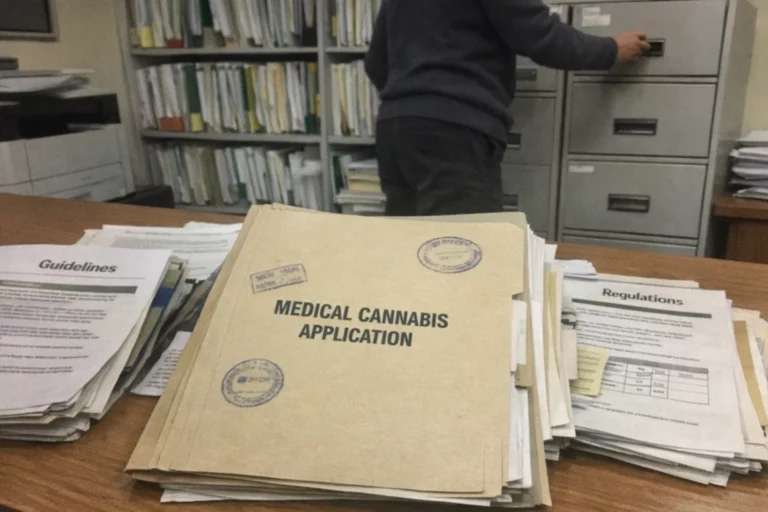
This context matters for understanding how South Africa's regulatory journey has unfolded. The Constitutional Court's landmark 2018 ruling decriminalised the private use and cultivation of cannabis, and the Cannabis for Private Purposes Act, signed into law in 2024, gave that ruling legislative substance for adult personal use. SAHPRA has incrementally developed its licensing framework for medicinal-grade production. The National Cannabis Master Plan, years in development across multiple government departments, theoretically provides a co-ordinated strategic framework. But as Botha observes, co-ordination at the policy document level has not translated into co-ordination at the operational level. Customs, provincial authorities, export promotion agencies, the Department of Agriculture, SAHPRA, and the DTIC are each playing a role, but there is no functional ecosystem pulling these actors into a coherent support structure for operators. Everyone is doing their part, just not together.
The economic cost of inaction is not abstract. Botha points out that capturing only ten percent of the projected R28 billion opportunity would still represent a R2.8 billion shortfall against stated targets. Should systemic gaps erode half the sector's potential value, the notional damage rises to R14 billion, before accounting for business failures, job losses, unpaid suppliers, forfeited tax revenue, and the reputational harm to South Africa as an origin country in international medicinal cannabis markets. Notably, the current framework disadvantages compliant operators across the board. Well-capitalised businesses that invest in doing things correctly are penalised by the same systemic gaps that exclude smaller and rural participants. That is a perverse outcome in a sector being promoted as a vehicle for inclusive economic growth and rural development.
Botha's prescription is direct: government must move beyond the licensing function and build, now-now, the infrastructure that allows operators to compete globally. His stated priorities include expedited pathways for genetics and seed imports, faster customs clearance of critical inputs, expanded and internationally accredited laboratory capacity, practical GMP support programmes for producers who cannot absorb compliance costs independently, and genuine market linkage initiatives that connect compliance investment to actual commercial revenue rather than leaving operators to source their own international buyers in a declining-price environment. These are not novel demands. Versions of them have been made by industry bodies for several years. The absence of progress, though, gives them renewed urgency.
Readers, investors, and cannabis operators should watch whether the DTIC's Cannabis Master Plan update translates into concrete inter-departmental commitments with timelines and accountability mechanisms, or whether it remains a planning document without operational consequence. The next meaningful indicator will be whether SAHPRA moves to expand accredited laboratory capacity or establish a recognised equivalence framework with regulators in key export markets such as the European Union and the United Kingdom. Without those building blocks in place, South Africa risks becoming a country that grows cannabis at regulatory cost and exports the opportunity to its competitors.
About the Author