BioCann Backs Indoor Precision and Canadian Genetics to Break Into Premium Export Markets
A cannabis producer based in Limpopo is making a deliberate push to position South Africa as a credible, pharmacy-grade flower supplier for Germany, the United Kingdom, and Australia. The company, BioCann, is doing this by pairing Health Canada-registered genetics with tightly controlled indoor growing conditions, the kind of quality architecture that premium medicinal markets increasingly demand before they will even consider a new supplier. BioCann describes itself as operating the largest commercial indoor cannabis facility in the country. It is now waiting on an EU-GMP inspection that its leadership believes is the final hurdle standing between the company and the full value of its export ambitions. The story of how BioCann got here is, in many ways, a practical guide to what any South African operator needs to do to compete at the top end of global medicinal cannabis trade.
The facility sits across seven licensed hectares of a 100-hectare farm in Limpopo, according to MMJ Daily. BioCann currently holds Good Agricultural and Collection Practices status under a South African Health Products Regulatory Authority licence, with Control Union providing independent third-party compliance oversight. CEO and co-founder Woody Chammas told the publication that the company's processing facility has been substantially rebuilt in preparation for the next certification stage. "We are GACP now, and the next stage is GMP," he said. "What has been done is an entire remodelling and renovation of our processing facility, new installation of HVAC units, internal renovation of all the rooms and all the areas, basically rebuilt from the inside. All that remains is the process validation, which will take us one step closer to our GMP compliance." EU-GMP equipment has already been imported, and an inspection is pending, MMJ Daily reported.
The SAHPRA licensing framework that governs operations like BioCann has come a long way since South Africa began regulating medicinal cannabis in earnest after the amendment of cannabis schedules in 2019, a process itself accelerated by the Constitutional Court's landmark 2018 ruling decriminalising private use. SAHPRA's Hemp and Cannabis Unit issues licences across cultivation, processing, and export categories, and the agency has been steadily refining its inspection and certification standards to bring them closer to international norms. EU-GMP certification is effectively a prerequisite for selling into Germany's pharmacy-distributed medicinal cannabis market, where quality documentation requirements rank among the most exacting in the world. South African producers who achieve that certification gain access to a German market that, since legalisation of medicinal cannabis in 2017 and further liberalisation under the 2024 CanG legislation, has become one of the most valuable in Europe. The regulatory path is demanding, but it is not impossible, and that matters enormously for an industry still finding its feet.
BioCann's genetics strategy is built around an established relationship with Segra International, a Canadian breeder whose cultivars carry Health Canada registration and a digital traceability fingerprint tracking each variety from tissue culture through laboratory testing. Chammas said the choice was deliberate from the company's earliest days. "They have the digital fingerprint of traceability of genetics, it's registered under Health Canada. Their genetics have a story behind them," he told MMJ Daily. "Integrity comes from the tissue lab and comes with a lot of testing, and we can import it into South Africa. We are strategically working with them since the beginning." The use of Health Canada-registered material is not merely a marketing credential. It provides the documented lineage and genetic consistency that pharmacies and distributors in regulated import markets require when they are deciding whether to list a product at all.
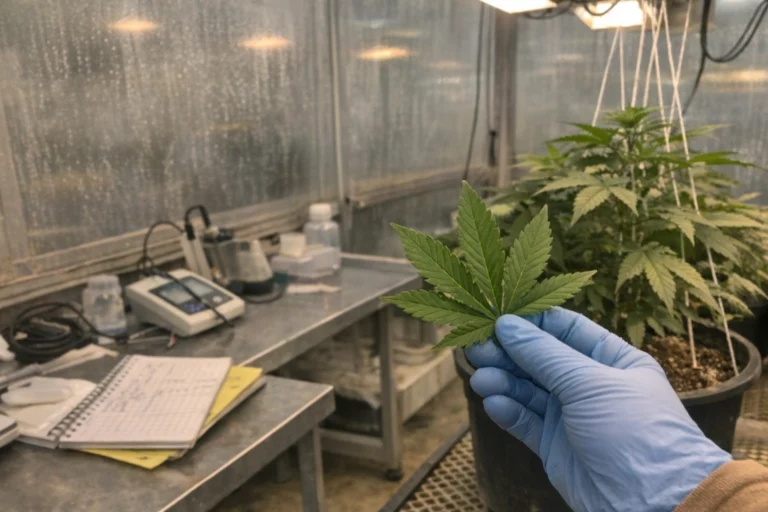
What sets BioCann's claims apart, though, is not the sourcing of genetics alone. It is the argument that indoor environmental control determines how completely any cultivar can express its genetic potential. General Manager Shaq Badat laid out the logic for MMJ Daily with some precision. "Any cultivator that understands genetics knows expression has two inputs: genetics potential and the environment that takes that potential out. Gene expression is dictated by the environment," he said. "When Segra would give the same genetics to a facility in a specific cultivation system, it would be night and day compared to the expression we get at BioCann due to the environmental controls we have. That's what sets us apart." The company supports these claims with Certificates of Analysis measuring terpene and cannabinoid concentrations, which Badat described as BioCann's primary proof point in commercial conversations with potential buyers.
Variety selection at BioCann follows a structured hierarchy that balances quality against commercial practicality. Cannabinoid and terpene profile come first, then flower morphology, growth habit, yield potential, and processability. "What is the flower expression? What's the morphology of the flower, the shape, the symmetry," Badat told MMJ Daily. "And we take it a step further: what is its cultivation habit, what's the yield potential, the processing potential, is it something difficult or easy to process. On the quality side, it's a measure of both quality and quantity capabilities." The dual focus on premium sensory profile and operational efficiency reflects a grower designing for export supply chains rather than local retail. In those chains, consistency and shelf presentation are scrutinised closely by importing distributors, and a single batch that disappoints can close doors that take years to reopen.
For now, the company's product focus sits firmly on premium indoor flower, with strain-specific extracts treated as a future diversification rather than an immediate priority. "Our primary focus is premium quality indoor flower, that's our differentiating production line in the market space right now," Badat said. "Later on we'll diversify our portfolio into strain-specific extracts. If we have strain X, you will also find it in extract form. But flower is our main focus right now." That sequencing makes strategic sense: flower commands higher per-gramme margins in Germany and Australia than most extract categories do, and building a reputation for consistent quality in flower first creates the kind of brand credibility that supports premium pricing when a broader product range eventually follows.
South Africa's cannabis export sector remains comparatively young when measured against established suppliers in Portugal, North Macedonia, and Colombia. Still, the country's combination of agricultural infrastructure, a maturing regulatory framework, and lower production costs gives it structural advantages that operators like BioCann are trying, now-now, to convert into meaningful market share. The outcome of the pending EU-GMP inspection will be a significant signal for the broader local industry. A successful certification would show that South African indoor producers can genuinely meet the documentation and quality management standards required to ship compliantly into the world's most demanding markets. Growers, investors, and policy-watchers would do well to follow that inspection result closely, because it will either validate or seriously complicate the export-led growth thesis that a growing number of licensed South African operators are building their entire businesses around.
About the Author